


Now that you have completed some initial research, begun to track grant opportunities, and maybe even reached out to a few local funders, it is time to turn your attention to proposal development and writing!
Let’s take a quick look at where you are in the grant life cycle.
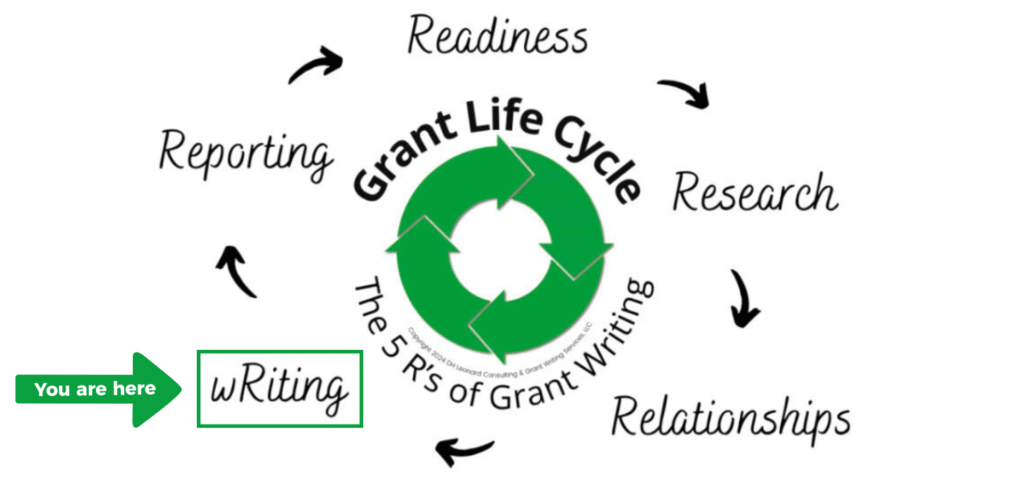
The proposal writing process encompasses three stages: the submission process, the proposal development process, and the writing process. Below are high-level descriptions of each stage as well as information and links to vetted trainings and tools. A list of common terms used can be found here on the Grant Terms page (coming soon).
Application Preparation and Submission
The application preparation and submission stage is where the prep work you completed to Get Grant Ready! comes together! This stage encompasses pre-writing work AND the steps taken to submit the proposal. During this stage, you will use the funder’s request for proposal (RFP) (also known as guidelines) and the application itself to complete the following steps.
Application Prep & Submission Pro-Tips
- Develop a writing, review and submission timeline with roles and responsibilities assigned to team members. Share this timeline with anyone who is responsible for reviewing drafts, sharing information for the application, or creating attachments (i.e. budgets or letters of support). See sample timelines below.
- Pro-Tip: To create the timeline, work backwards from the due date and include first, second, and final review deadlines, as well as when attachments should be finalized and shared with you. Aim to submit a grant application 24-hours before its due date/time.
- Create a grant folder specific to the opportunity and/or funder and save all the required administrative attachments and timelines in it. Share the location of this folder with other members of your team.
- Pro-Tip: Look through the required attachments and review what you already have on hand from the pre-application work you completed during the Get Grant Ready! process. Determine what needs to be completed by other team members or located.
- Upon receiving the RFP, determine if your grant will be submitted through a grant portal, by email, or snail mail. If the submission is through a portal, create an organizational account and/or check existing login credentials for the required portal right away.
- Pro-Tip: Consider creating a password protected excel sheet with names of funders, portal links, and corresponding login credentials. Share this with designated members of your team. This will allow them to access applications should you be unavailable to complete a submission.
- Create a narrative template using the application in the online portal and/or questions provided by the funder. This template will form the basis of your application. Save the template and any drafts in the grant folder you created earlier.
- Develop a writing, review and submission timeline with roles and responsibilities assigned to team members. Share this timeline with anyone who is responsible for reviewing drafts, sharing information for the application, or creating attachments (i.e. budgets or letters of support). See sample timelines below.
Pro-Tips:
- Hidden Text Boxes: As you are creating your narrative template, ALWAYS click through any drop-down features or multiple selection questions in an online version. Depending on how you answer a question, additional information or narrative responses may be required.
- Characters vs Word Limits: ALWAYS check what type and number limit is required in the online portal application for EACH narrative question. Include that information with each question in your template and track your counts (e.g. XXXX characters/3000 characters or XXXX/1000 words). Be aware that word or character counts can change question by question. If no count is provided, reach out to the funder to confirm the type and count OR cut and paste text to test each box as you are building your template.
Downloadable Tools:
- Sample Timelines: Note that timelines can be customized to each opportunity and can also serve as a checklist.
- Guides for Reference:
Proposal Development
The proposal development process focuses on program and budget planning. Some grant applications serve as opportunities to design and test a new way of implementing a program while others will allow you to strengthen an existing program through capacity building. Still other grant applications simply allow you to fund your existing operations. Before you start writing, we recommend using the following tools to develop a plan or case for your request.
Pro-Tips for Program Development
- Plan Ahead: When possible, take time outside of the proposal writing process to build a logic model or planning framework for your program or initiative. These tools often help you visualize all the program components that stem from broader strategic discussions. Note that it may take more than one discussion session to complete the tools.
- Know Thy Self: Use the narrative prep tools provided to develop language ahead of time. There are questions for which you can craft responses or gather data ahead of time. You will still need to customize these to each application, but using the Executive Summary or other templates above to begin drafting language will give you the head start you need once an opportunity presents itself.
- Get SMART!: Use your logic model or planning framework to develop a strong goal and set of SMART objectives for your program or specific grant request. If you need a refresher on SMART Goals, check out the Get Grant Ready! page.
- Be Grant Specific: For larger requests, funders may ask applicants to provide a logic model for a specific project they are being asked to fund. If they don’t provide a specific template for you to use, you can use the logic model template provided above. Don’t Worry! You don’t have to start from scratch. If you have an overall program logic model, you can use it as a starting point.
- Be a Joiner: If the funder is hosting any pre-application webinars or calls, be sure to attend. If you can’t attend, determine when they will make the webinar information available. The questions from other applicants are often the most interesting and helpful.
Program Design Tools
The following templates offer a general guide to the types of planning tools and frameworks used in grant program development.
AFSCME Job Training and Development Center Logic Model and Slides: Developed with AFSCME unions in mind, this logic model slide deck takes you through the components of a logic model and provides a completed example from a local affiliate.
- Logic Model Template (Word) – Please note that the instructions for completing the logic model are included in comments within the downloadable template.
- Logic Model Training (see Training Section)
GrantStation Project Planning Framework: Similar to the logic model format provided, this GrantStation format can also be used to layout the specific project or respond to a specific grant request. The Project Planning Framework includes the standard sections of a grant.
Narrative Prep Tools
The following templates and guidelines offer a general guide to the types of questions, attachments, and proposal structure that funders require for grant requests.
Proposal Templates
- Executive Summary Template: Don’t forget the Executive Summary Organizational Information Template you have been developing as a part of your efforts to Get Grant Ready!
- Funding for Good Grant Template Guide/Checklist: This checklist lays out a strong framework for developing language for typical sections of a grant request.
Pro-Tips: Budget Edition
After your narrative, your budget is the second most important part of your application. The budget has two parts: 1) the line-item budget AND 2) the budget narrative or budget justification. The narrative is the description of how you arrived at the costs in your budget and any necessary justifications. The budget form generally only includes costs associated with each line item of your budget. The budget narrative details how each line item was calculated and provides a brief justification of each item. When it comes to budgets, our team and the folks at GrantStation have a few tips:
- Budget Time for the Budget. Budgets and budget narratives can be tedious. If you are not comfortable crafting a budget, you will need to work with your finance team to help develop your budget and budget narrative request. Schedule time to review the grant application requirements with your finance team, making sure to build in time for reviews and updates as your application is developed and finalized.
- A quick note about cents: Unless a funder tells you differently, round up or down to the nearest dollar (round down below $0.50 and round up at $0.50 or above).
- Explain Yourself: Make sure you are detailed in all aspects of the budget. Do not include unexplained amounts for miscellaneous or contingency items.
- Check and Re-Check: Make sure your budget form and your budget narrative have the same numbers and calculations. These can easily get misaligned when you’re tweaking your budget, so it’s important to do a final check before submission.
Budget Prep Tools
For funders that provide their own budget templates, be sure to use their template and follow their specific instructions. Some funders request a budget but leave the presentation of the budget to the applicant. In this case, funders often still provide instructions, but not a specific form or format. Should you need a budget template, the following templates are available to assist with the development of your application’s budget.
Administrative Costs, Indirect Costs, Management or General Costs
The funder or granting agency will instruct you on which Administrative Costs, Indirect Costs, Management or General Costs are allowable and will usually provide a rate they will accept. For most private funders the rate is 10% while the Federal government sets the minimum rate at 15%.
Note: The federal government calls the minimum indirect cost rate the de minimus rate. To claim an indirect cost rate higher than minimum rate, nonprofit organizations are required to obtain a Negotiated Indirect Cost Rate Agreement (NICRA). This process varies from federal agency to federal agency. You will need to identify a federal agency you want to apply to and download their indirect cost proposal instructions and have your finance team or work with an accountant to prepare the proposal for you. You then submit this to the federal agency for approval.
Some federal grant applications require grantees to use a Modified Indirect Cost Rate (MTDC) to calculate the indirect cost rate of your proposed program budget verses calculating indirect costs on the total direct costs.
Writing Process
With your submission process underway and planning process complete, it is finally time to start writing. Turning to your narrative template, consider the following:
- Deviations = deduction in points for reviewers. Always follow the funder’s required format and instructions. Each application will have its own set of instructions for completion and submission. They want to see information laid out where they requested it even if it feels a bit chopped up.
- New vs Old. At first review, note if there are any sections or questions in the application where you might repurpose existing language OR you will need to develop brand new language. Note: New Language will take time to develop, so plan accordingly.
- Copy and Paste? Some questions may sound similar to questions you have answered in prior requests. While we don’t recommend a straight copy and paste of grant language from one funder to the next, feel free to use a similar past response as a starting point or inspiration for your new response. Be sure to adapt the response to adequately answer the new funder’s question.
- Customize your answers to the specific funder using what you learn through research and relationships, the RFP, and pre-application webinars.
- Answer questions COMPLETELY. Some funders will ask you to answer multiple questions under one response or section. Read over your responses to make sure you have responded to each question asked.
- Be active, not passive, in your language. For example,
- Passive: “The Registered Apprenticeship (RAP) was developed by our union.”
- Active: “Our union developed a Registered Apprenticeship Program (RAP).”
- Take a writing break—if possible, several days or more—and then revisit your writing. This allows you to catch missing words or missing concepts.
- Never assume the reviewer understands your goal or program. This is your opportunity to explain why and how your program will help address gaps or challenges in your community.
- Don’t take edits personally! Reviewers offer a different perspective and voice. Use that to strengthen your request.
Internal & External Trainings
When it comes to proposal writing and development, the information provided in this toolkit should not be substituted for a proposal writing course or training. If you are new to proposal writing or development, we recommend the following internal resources developed by AFSCME and external grant writing professionals and associations for more in-depth training.
Internal Trainings
AFSCME Logic Model Training
A logic model is a tool often used to support program design activities or convey the impact an organization hopes to make. Private funders often request applicants submit a logic model as an attachment with a grant request application. The following 3 – 4 min videos breakdown what a logic model is and the steps for creating a program- or grant-specific logic model.
Overview
Before You Start
Outputs & Outcomes
Putting It All Together
External Trainings
These sites and professionals offer a mix of free and paid resources, blog posts, and weekly newsletters to support you and your grant program. Courses range from Grants 101 and Program/Project Budget Development to specific grant writing support for state and federal proposals. These resources will help you create your organizational background, statement of need, program methodology and approach, as well as craft an evaluation plan and create project budgets and budget narratives.
*Annual memberships to these fundraising and grant program resource sites allow you to gain access to more robust trainings for free or reduced prices in addition to the online resources mentioned in the Research and Outreach Section.
Application Prep & Submission
The submission process is the stage where the prep work you completed to Get Grant Ready! comes together! This stage encompasses pre-writing work AND the steps taken to submit the proposal. During this stage, you will use the funder’s request for proposal (RFP) (also known as guidelines) and the application itself to complete the following steps.
Pro-Tips
Application Prep & Submission Pro-Tips
- Develop a writing, review and submission timeline with roles and responsibilities assigned to team members. Share this timeline with anyone who is responsible for reviewing drafts, sharing information for the application, or creating attachments (i.e. budgets or letters of support). See sample timelines below.
- Pro-Tip: To create the timeline, work backwards from the due date and include first, second, and final review deadlines, as well as when attachments should be finalized and shared with you. Aim to submit a grant application 24-hours before its due date/time.
- Create a grant folder specific to the opportunity and/or funder and save all the required administrative attachments and timelines in it. Share the location of this folder with other members of your team.
- Pro-Tip: Look through the required attachments and review what you already have on hand from the pre-application work you completed during the Get Grant Ready! process. Determine what needs to be completed by other team members or located.
- Upon receiving the RFP, determine if your grant will be submitted through a grant portal, by email, or snail mail. If the submission is through a portal, create an organizational account and/or check existing login credentials for the required portal right away.
- Pro-Tip: Consider creating a password protected excel sheet with names of funders, portal links, and corresponding login credentials. Share this with designated members of your team. This will allow them to access applications should you be unavailable to complete a submission.
- Create a narrative template using the application in the online portal and/or questions provided by the funder. This template will form the basis of your application. Save the template and any drafts in the grant folder you created earlier.
Pro-Tips
- Hidden Text Boxes: As you are creating your narrative template, ALWAYS click through any drop-down features or multiple selection questions in an online version. Depending on how you answer a question, additional information or narrative responses may be required.
- Characters vs Word Limits: ALWAYS check what type and number limit is required in the online portal application for EACH narrative question. Include that information with each question in your template and track your counts (e.g. XXXX characters/3000 characters or XXXX/1000 words). Be aware that word or character counts can change question by question. If no count is provided, reach out to the funder to confirm the type and count OR cut and paste text to test each box as you are building your template.
Downloadable Tools
- Sample Timelines: Note that timelines can be customized to each opportunity and can also serve as a checklist.
- Guides for Reference:
Proposal Development
The proposal development process focuses on program and budget planning. Some grant applications serve as opportunities to design and test a new way of implementing a program while others will allow you to strengthen an existing program through capacity building. Still other grant applications simply allow you to fund your existing operations. Before you start writing, we recommend using the following tools to develop a plan or case for your request.
Pro-tips for Program Development
- Plan Ahead: When possible, take time outside of the proposal writing process to build a logic model or planning framework for your program or initiative. These tools often help you visualize all the program components that stem from broader strategic discussions. Note that it may take more than one discussion session to complete the tools.
- Know Thy Self: Use the narrative prep tools provided to develop language ahead of time. There are questions for which you can craft responses or gather data ahead of time. You will still need to customize these to each application, but using the Executive Summary or other templates above to begin drafting language will give you the head start you need once an opportunity presents itself.
- Get SMART!: Use your logic model or planning framework to develop a strong goal and set of SMART objectives for your program or specific grant request. If you need a refresher on SMART Goals, check out the Get Grant Ready! page.
- Be Grant Specific: For larger requests, funders may ask applicants to provide a logic model for a specific project they are being asked to fund. If they don’t provide a specific template for you to use, you can use the logic model template provided above. Don’t Worry! You don’t have to start from scratch. If you have an overall program logic model, you can use it as a starting point.
- Be a Joiner: If the funder is hosting any pre-application webinars or calls, be sure to attend. If you can’t attend, determine when they will make the webinar information available. The questions from other applicants are often the most interesting and helpful.
Program Design Tools
The following templates offer a general guide to the types of planning tools and frameworks used in grant program development.
AFSCME Job Training and Development Center Logic Model and Slides: Developed with AFSCME unions in mind, this logic model slide deck takes you through the components of a logic model and provides a completed example from a local affiliate.
- Logic Model Template (Word) – Please note that the instructions for completing the logic model are included in comments within the downloadable template.
- Logic Model Training (see Training Section)
GrantStation Project Planning Framework: Similar to the logic model format provided, this GrantStation format can also be used to layout the specific project or respond to a specific grant request. The Project Planning Framework includes the standard sections of a grant.
Narrative Prep Tools
The following templates and guidelines offer a general guide to the types of questions, attachments, and proposal structure that funders require for grant requests.
Proposal Templates
- Executive Summary Template: Don’t forget the Executive Summary Organizational Information Template you have been developing as a part of your efforts to Get Grant Ready!
- Funding for Good Grant Template Guide/Checklist: This checklist lays out a strong framework for developing language for typical sections of a grant request.
Pro-Tips: Budget Edition
After your narrative, your budget is the second most important part of your application. The budget has two parts: 1) the line-item budget AND 2) the budget narrative or budget justification. The narrative is the description of how you arrived at the costs in your budget and any necessary justifications. The budget form generally only includes costs associated with each line item of your budget. The budget narrative details how each line item was calculated and provides a brief justification of each item. When it comes to budgets, our team and the folks at GrantStation have a few tips:
- Budget Time for the Budget. Budgets and budget narratives can be tedious. If you are not comfortable crafting a budget, you will need to work with your finance team to help develop your budget and budget narrative request. Schedule time to review the grant application requirements with your finance team, making sure to build in time for reviews and updates as your application is developed and finalized.
- A quick note about cents: Unless a funder tells you differently, round up or down to the nearest dollar (round down below $0.50 and round up at $0.50 or above).
- Explain Yourself: Make sure you are detailed in all aspects of the budget. Do not include unexplained amounts for miscellaneous or contingency items.
- Check and Re-Check: Make sure your budget form and your budget narrative have the same numbers and calculations. These can easily get misaligned when you’re tweaking your budget, so it’s important to do a final check before submission.
Budget Prep Tools
For funders that provide their own budget templates, be sure to use their template and follow their specific instructions. Some funders request a budget but leave the presentation of the budget to the applicant. In this case, funders often still provide instructions, but not a specific form or format. Should you need a budget template, the following templates are available to assist with the development of your application’s budget.
Administrative Costs, Indirect Costs, Management or General Costs
The funder or granting agency will instruct you on which Administrative Costs, Indirect Costs, Management or General Costs are allowable and will usually provide a rate they will accept. For most private funders the rate is 10% while the Federal government sets the minimum rate at 15%.
Note: The federal government calls the minimum indirect cost rate the de minimus rate. To claim an indirect cost rate higher than minimum rate, nonprofit organizations are required to obtain a Negotiated Indirect Cost Rate Agreement (NICRA). This process varies from federal agency to federal agency. You will need to identify a federal agency you want to apply to and download their indirect cost proposal instructions and have your finance team or work with an accountant to prepare the proposal for you. You then submit this to the federal agency for approval.
Some federal grant applications require grantees to use a Modified Indirect Cost Rate (MTDC) to calculate the indirect cost rate of your proposed program budget verses calculating indirect costs on the total direct costs.
Writing Process
With your submission process underway and planning process complete, it is finally time to start writing. Turning to your narrative template, consider the following:
- Deviations = deduction in points for reviewers. Always follow the funder’s required format and instructions. Each application will have its own set of instructions for completion and submission. They want to see information laid out where they requested it even if it feels a bit chopped up.
- New vs Old. At first review, note if there are any sections or questions in the application where you might repurpose existing language OR you will need to develop brand new language. Note: New Language will take time to develop, so plan accordingly.
- Copy and Paste? Some questions may sound similar to questions you have answered in prior requests. While we don’t recommend a straight copy and paste of grant language from one funder to the next, feel free to use a similar past response as a starting point or inspiration for your new response. Be sure to adapt the response to adequately answer the new funder’s question.
- Customize your answers to the specific funder using what you learn through research and relationships, the RFP, and pre-application webinars.
- Answer questions COMPLETELY. Some funders will ask you to answer multiple questions under one response or section. Read over your responses to make sure you have responded to each question asked.
- Be active, not passive, in your language. For example,
- Passive: “The Registered Apprenticeship (RAP) was developed by our union.”
- Active: “Our union developed a Registered Apprenticeship Program (RAP).”
- Take a writing break—if possible, several days or more—and then revisit your writing. This allows you to catch missing words or missing concepts.
- Never assume the reviewer understands your goal or program. This is your opportunity to explain why and how your program will help address gaps or challenges in your community.
- Don’t take edits personally! Reviewers offer a different perspective and voice. Use that to strengthen your request.
Internal Training
If you are new to proposal writing or development, we recommend the following resources developed by AFSCME and external grant writing professionals and associations for more in-depth training.
Logic Model Training
Overview
Pre-Work
Implementation Components
Putting It All Together
External Training
If you are new to proposal writing or development, we recommend the following resources developed by AFSCME and external grant writing professionals and associations for more in-depth training.
When it comes to proposal writing and development the information provided in this toolkit should not be substituted for a proposal writing course or training. These sites and professionals offer a mix of free and paid resources, blog posts, and weekly newsletters to support you and your grant program. Courses range from Grants 101 and Program/Project Budget Development to specific grant writing support for state and federal proposals. These resources will help you create your organizational background, statement of need, program methodology and approach, as well as craft an evaluation plan and create project budgets and budget narratives.
*Annual memberships to these fundraising and grant program resource sites allow you to gain access to more robust trainings for free or reduced prices in addition to the online resources mentioned in the Research and Outreach Section.

Contact Us
We are here for you!
Please contact us if you have a question, concern, or request regarding workforce development grants.
research@afscme.org