
ASK A RESEARCHER

The Threat of Skills-Based Pay

How Skills-Based Pay Threatens AFSCME Members & All Workers

Reducing the number of classifications within a title series by vertically consolidating them gives management more discretion over work assignments and pay, limits the opportunity for workers to achieve promotions and undercuts their economic security. It also undermines our union’s ability to collectively bargain for transparent, equitable wages, where each worker has the same access and opportunities to seek promotions based on consistent, clearly defined and objective criteria.  Click on each threat below to learn more.

Pay can fluctuate yearly, quarterly, weekly or by pay period based on the skills management prioritizes and the worker is given the opportunity to demonstrate for that given time period. A worker’s base pay may be lowered and the difference, in whole or in part, offered as a SBP supplement.

Pay can fluctuate yearly, quarterly, weekly or by pay period based on the skills management prioritizes and the worker is given the opportunity to demonstrate for that given time period. A worker’s base pay may be lowered and the difference, in whole or in part, offered as a SBP supplement.

Basing workers’ pay on their demonstration of prioritized skills gives individual managers tremendous control over their employee’s pay. Furthermore, they may control access to the type of work assignments that will use the prioritized skills. This level of subjectivity gives managers increased opportunities to exercise bias, whether conscious or unconscious. It also opens the door to the kind of exploitation and corruption our union has long been fighting against. With SBP, individual managers are empowered to fundamentally impact members’ paychecks, daily working conditions and long-term career trajectory

Competition and perceived bias over work assignments that are tied to pay inevitably creates tension and division among workers which is likely to both undermine overall productivity and weaken member solidarity.

Positions require workers to utilize a combination of knowledge, skills and abilities. Paying for individual skill utilization ignores the interplay among skill sets, the culminative nature of acquiring and applying skill sets and the full breadth and depth of knowledge, ability and judgement that workers use on the job. As a result, SBP undermines fair market wages by undervaluing a worker’s true market value to their employer.

Job classifications are a foundational component of a merit-based civil service system. Job classifications are intended to group together similar positions under a standardized pay structure. Classifications within a title series clearly demarcate individual job responsibilities and tasks. This allows for transparency and advancement opportunities with predictable and permanent wage increases, as reflected in most contract wage scales. However, it is easier to implement SBP when compensation and skill ranges are defined more broadly than they are in most job classification systems. 

Reducing the number of classifications within a title series by vertically consolidating them gives management more discretion over work assignments and pay, limits the opportunity for workers to achieve promotions and undercuts their economic security. It also undermines our union’s ability to collectively bargain for transparent, equitable wages, where each worker has the same access and opportunities to seek promotions based on consistent, clearly defined and objective criteria.
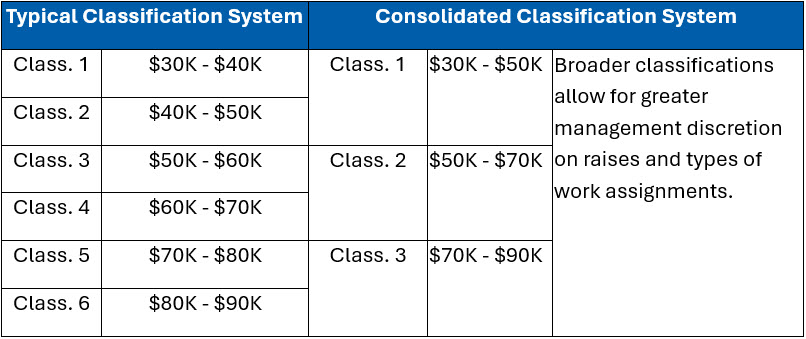
Even where classifications are not being vertically consolidated, demands to limit labor costs can still undermine the classification system. Under pressure to limit personnel spending, managers may try to designate enhanced SBP for specific skills normally used in a higher classified position instead of designating the worker as temporarily “working out of class” (during which they should receive the higher classification’s wage for that period), working on a stretch assignment (geared toward preparing for permanent promotion) or permanently promoting a worker into the higher classification.  

Warning Signs

Be on the lookout for changes to the employee evaluation process which could indicate that your employer might be positioning to transition to SBP. These include changes to rating categories, who does the evaluations and the frequency of the evaluations.

Contact Us

We are here for you! Please contact us if you have a question, concern, or request regarding workforce development.
research@afscme.org