




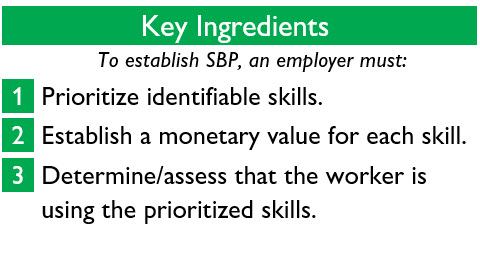
There are two main types of SBP. Both approaches limit long-term pay commitments.
1 Workers are paid for the skills they use on a specific project or during a specific time frame.
This treats compensation like an ala cart menu of paid job skills. Under the simplest terms, management pays for what they want, when they want, for as long as they want. A worker’s pay fluctuates according to the skills that management prioritizes and the opportunities available for a worker to demonstrate their skills on the job. The pay fluctuation could be from week to week or year to year.
2 Workers pay raises are based on an evaluation of a worker’s skills as prioritized by management.
This type of SBP has been used to replace longevity or step increases.
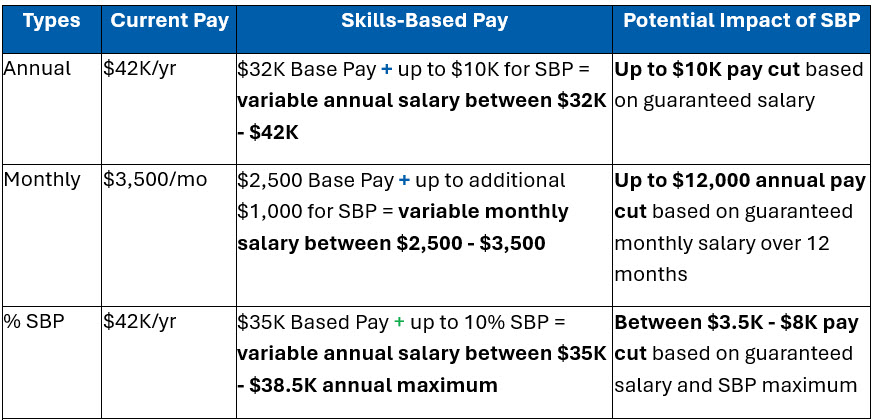

SBP is fundamentally different from other types of incentive pay.
SBP is NOT Credential Pay – Credential pay is when a worker receives a pay differential for skill or credential attainment. Unlike SBP, credential pay does not fundamentally change the pay structure; a position’s base pay is not lowered as with SBP. Credential pay is collectively bargained and awarded objectively for skill or credential attainment through a recognized training or education provider, not a manager’s subjective determination of whether the worker has demonstrated a particular skill. Most credential pay is based on “industry recognized” and “portable” credentials that remain relevant regardless of the particular employer.
SBP is NOT Performance Pay – Performance pay is generally designed to pay workers a bonus for achieving certain productivity or outcome results. In contrast, SBP is designed to pay workers for discreet skills that they utilize on the job.
